🧠 Easy Classic Riddles
- What gets wetter the more it dries? 👉 A towel
- What has hands but cannot clap? 👉 A clock
- What has teeth but cannot bite? 👉 A comb
- What has a neck but no head? 👉 A bottle
- What has one eye but cannot see? 👉 A needle
- What has a face but no eyes? 👉 A clock
- What has legs but cannot walk? 👉 A table
- What has a thumb and four fingers but is not alive? 👉 A glove
- What has a head and a tail but no body? 👉 A coin
- What can you catch but never throw? 👉 A cold
- What has words but never speaks? 👉 A book
- What belongs to you but other people use more than you do? 👉 Your name
- What can travel around the world while staying in one corner? 👉 A stamp
- What gets bigger the more you take away? 👉 A hole
- What can be broken without being touched? 👉 A promise
🤯 Famous Classic Riddles
- What has a bed but never sleeps, a mouth but never eats, and runs but never walks? 👉 A river
- What can fill a room but takes up no space? 👉 Light
- What is always in front of you but can never be seen? 👉 The future
- What disappears as soon as you say its name? 👉 Silence
- What comes down but never goes up? 👉 Rain
- What goes up but never comes down? 👉 Your age
- What has branches but no leaves, no trunk, and no fruit? 👉 A bank
- What has cities, roads, and rivers but no people, cars, or water? 👉 A map
- What has four legs in the morning, two at noon, and three in the evening? 👉 A human
- What can be seen once in a minute, twice in a moment, and never in a thousand years? 👉 The letter M
- What is so fragile that saying its name breaks it? 👉 Silence
- What can you keep after giving it to someone? 👉 Your word
- What has a bottom at the top? 👉 Your legs
- What can run but never walks? 👉 Water
- What can be heard but never seen or touched? 👉 Sound
⏰ Classic Clock Riddles
- I have hands but never clap. 👉 A clock
- I have a face but never smile. 👉 A clock
- I tick but never talk. 👉 A clock
- I have numbers but never do homework. 👉 A clock
- I go around in circles but never get dizzy. 👉 A clock
- I can wake you up without touching you. 👉 An alarm clock
- I have a second hand but never hold hands. 👉 A clock
- I have a minute hand but never wave. 👉 A clock
- I can strike but never fight. 👉 A clock
- I can lose time without getting lost. 👉 A clock
- I can be wound up but never become angry. 👉 A clock
- I can run all day without having legs. 👉 A clock
- I can hang on a wall without being a picture. 👉 A clock
- I can have twelve numbers but never count them myself. 👉 A clock
- I tell you something that never stops passing. 👉 A clock
🌊 Classic River Riddles
- I have a mouth but never eat. 👉 A river
- I have a bed but never sleep. 👉 A river
- I have banks but never hold money. 👉 A river
- I run but never walk. 👉 A river
- I have a current but never owe anyone money. 👉 A river
- I can have a fork but never eat dinner. 👉 A river
- I can have a channel but never watch television. 👉 A river
- I can have a delta but never sell anything. 👉 A river
- I can carry boats but never buy tickets. 👉 A river
- I can flow into the sea without ever swimming. 👉 A river
📖 Classic Book Riddles
- I have a spine but no bones. 👉 A book
- I have pages but no legs. 👉 A book
- I have a cover but never get cold. 👉 A book
- I can tell stories without speaking. 👉 A book
- I can have chapters but never attend school. 👉 A book
- I can take you around the world without moving. 👉 A book
- I can have characters but never become a person. 👉 A book
- I can be opened but am not a door. 👉 A book
- I can contain mysteries but am not a detective. 👉 A book
- I can sit on a shelf for years without getting bored. 👉 A book
🪞 Classic Shadow Riddles
- I follow you everywhere but never speak. 👉 A shadow
- I copy your shape but am not alive. 👉 A shadow
- I disappear in complete darkness. 👉 A shadow
- I grow longer when the Sun is low. 👉 A shadow
- I appear when light is blocked. 👉 A shadow
- I can move when you move without having legs. 👉 A shadow
- I can be behind you without sneaking up on you. 👉 A shadow
- I can stretch across the ground without growing. 👉 A shadow
- I have no color of my own but often look dark. 👉 A shadow
- I need light to exist but am not light. 👉 A shadow
🪥 Classic Everyday Object Riddles
- What has many keys but cannot open a door? 👉 A piano
- What has a ring but no finger? 👉 A telephone
- What has a tongue but cannot taste? 👉 A shoe
- What has a foot but no legs? 👉 A ruler
- What has a thumb but is not alive? 👉 A glove
- What has teeth but cannot chew? 👉 A comb
- What has a head but never thinks? 👉 A nail
- What has an eye but cannot see? 👉 A needle
- What has a lid but cannot open itself? 👉 A box
- What has a lock but no door? 👉 A suitcase
😂 Funny Classic Riddles
- What kind of room has no doors or windows? 👉 A mushroom
- What has a bark but no bite? 👉 A tree
- What has ears but cannot hear? 👉 Corn
- What has a tongue but cannot talk? 👉 A shoe
- What has a neck but no head? 👉 A bottle
- What has four legs but cannot walk? 👉 A table
- What has a bed but never sleeps? 👉 A river
- What can you serve but never eat? 👉 A tennis ball
- What can be cracked, made, told, and played? 👉 A joke
- What kind of coat can only be put on when wet? 👉 A coat of paint
- What has a heart that never beats? 👉 An artichoke
- What has an eye but cannot see? 👉 A potato
- What has branches but no leaves? 👉 A bank
- What has a head, a tail, is brown, and has no legs? 👉 A penny
- What can go through glass without breaking it? 👉 Light
🪤 Classic Trick Riddles
- If you are running a race and pass the person in second place, what place are you in? 👉 Second place
- How many months have 28 days? 👉 All 12
- A rooster lays an egg on a roof. Which way does it roll? 👉 Roosters do not lay eggs
- A plane crashes on the border of two countries. Where do they bury the survivors? 👉 They don’t bury survivors
- If you take two apples from three apples, how many do you have? 👉 Two
- Before Mount Everest was discovered, what was the highest mountain? 👉 Mount Everest
- What can you never eat for breakfast? 👉 Lunch and dinner
- If an electric train travels north, which way does its smoke go? 👉 It has no smoke
- A farmer has 17 sheep. All but 9 run away. How many remain? 👉 Nine
- You have one match and enter a dark room with a candle, lamp, and fireplace. What do you light first? 👉 The match
- If yesterday was tomorrow, today would be Friday. What day is today? 👉 Wednesday
- A doctor gives you three pills and tells you to take one every 30 minutes. How long do they last? 👉 One hour
- If you drop a yellow hat into the Red Sea, what does it become? 👉 Wet
- How far can a dog run into the woods? 👉 Halfway
- A farmer has five cows and all but two die. How many are left? 👉 Two
🔤 Classic Wordplay Riddles
- What word becomes shorter when you add two letters? 👉 Short
- What word is spelled incorrectly in every dictionary? 👉 Incorrectly
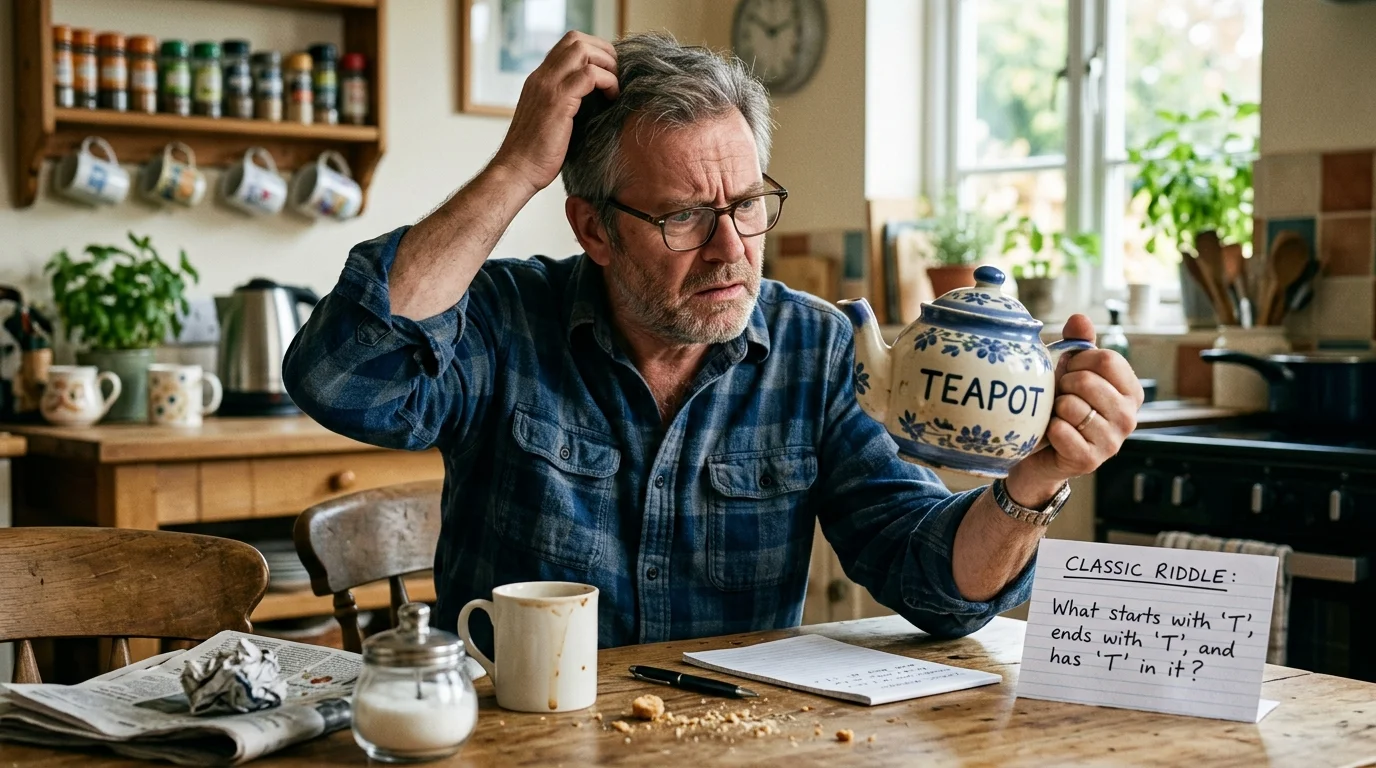
- What begins with T, ends with T, and has T in it? 👉 A teapot
- What begins with E, ends with E, and contains one letter? 👉 An envelope
- What can you see once in a year, twice in a week, and never in a day? 👉 The letter E
- What is at the beginning of eternity, the end of time, and the beginning of every end? 👉 The letter E
- What five-letter word becomes shorter when you add two letters? 👉 Short
- What has 26 letters but only one syllable? 👉 The alphabet
- What starts with P and ends with E and has thousands of letters? 👉 A post office
- What English word is pronounced the same even after four of its five letters are removed? 👉 Queue
- What has many letters but never sends mail? 👉 A mailbox
- What word can be read the same forward and backward? 👉 A palindrome
- What can be spelled with two letters but becomes longer with one more? 👉 A wordplay puzzle
- What word contains every vowel in order? 👉 A word with all five vowels in sequence
- What starts and ends with the same letter? 👉 Many words
👨👩👧 Classic Family Riddles
- Two fathers and two sons go fishing and catch three fish. Each gets one. How? 👉 They are a grandfather, father, and son
- Two mothers and two daughters go shopping and buy three dresses. Each gets one. How? 👉 They are a grandmother, mother, and daughter
- A family has five sons. Each son has one sister. How many children? 👉 Six
- A man has three daughters. Each daughter has one brother. How many children? 👉 Four
- A father and son have an accident. The father dies, and the surgeon says, “He is my son.” Who is the surgeon? 👉 His mother
- Two people have the same parents and birthday but are not twins. How? 👉 They are part of a larger set of multiple births
- A grandfather, father, and son go fishing. They catch three fish. How many people? 👉 Three
- A family has two parents and six sons. Each son has one sister. How many children? 👉 Seven
- One woman has seven children. Every child has the same mother. How many mothers? 👉 One
- A mother has four daughters, and each has one brother. How many children? 👉 Five
🔢 Classic Number Riddles
- I am an odd number. Remove one letter and I become even. 👉 Seven
- What number becomes smaller when turned upside down? 👉 9 becomes 6
- What is half of two plus two? 👉 Three, depending on the intended interpretation
- What three positive whole numbers give the same result when added and multiplied? 👉 1, 2, and 3
- What is the smallest positive even prime number? 👉 2
- If two is company and three is a crowd, what are four and five? 👉 Nine
- What comes next: 2, 4, 8, 16, 32? 👉 64
- What comes next: 1, 1, 2, 3, 5, 8? 👉 13
- What number has the same number of letters as its value? 👉 Four
- If you have three apples and take away two, how many do you have? 👉 Two
🧩 Classic Logic Riddles
- A farmer has chickens and cows. There are 10 heads and 28 legs. How many chickens? 👉 Six
- You enter a room with 10 people. Six leave. How many remain? 👉 Four
- A clock strikes six in five seconds. How long does it take to strike twelve? 👉 Eleven seconds
- A man pushes his car to a hotel and knows he is bankrupt. Why? 👉 He is playing Monopoly
- A person asks for water at a restaurant. The waiter points a gun at them. The person says thank you and leaves. Why? 👉 They had hiccups
- A woman shoots her husband, holds him underwater, then hangs him, but later they eat dinner together. How? 👉 She took his photograph
- A man is found hanging in a locked room with water beneath him. How? 👉 He stood on melting ice
- A crime scene has broken glass and water on the floor. What happened? 👉 A fishbowl broke
- A lighthouse keeper turns off a light and hundreds die. Why? 👉 He turned off a lighthouse
- A man is found with a tape recorder and a gunshot on the recording. Why might police suspect foul play? 👉 Someone had to set or rewind the recording afterward
🪙 Classic Money and Object Riddles
- What has a head and tail but no body? 👉 A coin
- What can be put in a bucket to make it lighter? 👉 A hole
- What has a bank but no money? 👉 A river
- What has a ring but no finger? 👉 A telephone
- What has keys but cannot open locks? 👉 A piano
- What has a lock but no key? 👉 A canal
- What has a handle but cannot open a door? 👉 A cup
- What has a bottom but no top? 👉 A leg
- What can be held without being touched? 👉 A conversation
- What can be given and still kept? 👉 Your word
🧠 Hard Classic Riddles
- What has no beginning, end, or middle? 👉 A circle
- What can travel around the world while staying in one corner? 👉 A stamp
- What can you hold in your right hand but never in your left? 👉 Your left hand
- What can run but never walks, has a mouth but never talks, and has a bed but never sleeps? 👉 A river
- What is always in front of you but can never be seen? 👉 The future
- What gets bigger the more you take away? 👉 A hole
- What disappears the moment you say its name? 👉 Silence
- What can be lost without ever being held? 👉 Time
- What can be broken without being touched? 👉 A promise
- What can fill a room without taking up space? 👉 Light
- What belongs to you but other people use more than you do? 👉 Your name
- What comes once in a minute, twice in a moment, and never in a thousand years? 👉 The letter M
- What has four legs in the morning, two at noon, and three in the evening? 👉 A human
- What has cities but no buildings, rivers but no water, and forests but no trees? 👉 A map
- What is so fragile that saying its name breaks it? 👉 Silence
🏫 Classic Riddles for Teachers and Classrooms
- I can turn a lesson into a fun guessing game. 👉 A classic riddle
- I can help students practice careful reading. 👉 A riddle
- I can teach vocabulary through wordplay. 👉 A classic riddle
- I can become a quick classroom brain break. 👉 A riddle
- I can introduce logic and reasoning. 👉 A logic riddle
- I can help students practice basic mathematics. 👉 A number riddle
- I can encourage students to think about multiple meanings. 👉 A wordplay riddle
- I can become a creative writing prompt. 👉 A riddle
- I can help students practice listening carefully. 👉 A spoken riddle
- I can encourage students to create their own puzzles. 👉 A riddle-writing activity
- I can make an ordinary object feel mysterious. 👉 A classic riddle
- I can combine reading, logic, vocabulary, and creativity. 👉 A riddle activity
- I can be used as an opening activity or lesson break. 👉 A classroom riddle
- I can challenge students without requiring complicated equipment. 👉 A riddle
- I am a simple way to make thinking fun. 👉 A classic riddle
🎉 Classic Riddles for Family Games
- I have hands but cannot clap. 👉 A clock
- I get wetter the more I dry. 👉 A towel
- I have teeth but cannot bite. 👉 A comb
- I have a neck but no head. 👉 A bottle
- I have one eye but cannot see. 👉 A needle
- I have a spine but no bones. 👉 A book
- I have a mouth but never eat. 👉 A river
- I have a face but cannot smile. 👉 A clock
- I have a head and tail but no body. 👉 A coin
- I have keys but cannot open doors. 👉 A piano
- I have a bark but no bite. 👉 A tree
- I can fill a room without taking space. 👉 Light
- I disappear when you say my name. 👉 Silence
- I go up but never come down. 👉 Your age
- I belong to you but others use me more than you do. 👉 Your name
🔍 How to Create Your Own Classic Riddles
Classic riddles work because they make ordinary things sound mysterious.
Start with familiar subjects such as clocks, books, rivers, shadows, coins, trees, names, tools, animals, and everyday objects.
A simple formula works well: describe two or three unusual features without naming the object.
For example, a clock can have a face without eyes, hands without fingers, and a ticking sound without ever speaking.
Wordplay is another powerful technique. Use words with multiple meanings, such as bank, mouth, bed, head, foot, or hand.
For trick questions, make sure the answer depends on the exact wording rather than an unfair technicality.
The best classic riddles are short, memorable, and satisfying once the answer is revealed.